

Leadership Traits that Separate Strong Companies from the Rest
Business leadership refers to the ability of an individual to guide an organization, team, or enterprise toward sustainable results while balancing people, performance, and purpose. In today’s environment, marked by volatility, scrutiny, and rapid change, leadership is less about positional authority and more about consistent behaviors that earn trust and drive outcomes.
Strong leaders are not born from charisma alone. They are shaped by judgment, clarity, discipline, and an ability to adapt without losing their center. Below is a practical exploration of the qualities and characteristics that consistently define effective business leadership.
A Quick Orientation for Leaders in Motion
Effective leaders align direction, people, and decisions. They communicate clearly, act with integrity, and remain accountable, especially when conditions are messy. The result is momentum: teams know where they’re going, why it matters, and what good looks like.
Strategic Clarity Without Tunnel Vision
Leadership begins with clarity of direction. Effective leaders articulate a compelling vision, but they avoid rigid thinking. They know where the organization is headed while remaining open to recalibration as facts change.
Clarity shows up in priorities. Teams flounder when everything is urgent. Strong leaders make trade-offs visible and intentional. They say no more often than yes, and explain why.
Emotional Intelligence as a Performance Tool
Emotional intelligence isn’t a “soft” skill; it’s a performance multiplier. Leaders who recognize emotions, their own and others’, manage conflict more productively, motivate more effectively, and build resilient cultures.
This doesn’t mean avoiding hard conversations. It means handling them with composure, empathy, and respect. Teams led this way recover faster from setbacks and maintain focus under pressure.
Core Leadership Qualities That Consistently Matter
● Integrity: Doing what you say, especially when it’s inconvenient
● Accountability: Owning outcomes without deflecting blame
● Decisiveness: Making timely calls with incomplete information
● Adaptability: Adjusting strategy without abandoning values
● Communication: Explaining decisions clearly and consistently
These traits don’t rotate in and out of relevance. They compound over time.
Decision-Making Under Real Constraints
Leaders are paid to decide, not to deliberate endlessly. Effective decision-making balances speed with judgment. High-performing leaders gather input broadly, decide clearly, and then commit fully.
They also distinguish between reversible and irreversible decisions. Not every choice needs consensus. Knowing when to move fast, and when to slow down, is a learned discipline.
Learning From Leaders Beyond Your Industry
No leader develops in isolation. Exposure to different sectors, roles, and leadership paths sharpens perspective. Studying accomplished professionals across industries reveals how values like service, discipline, and resilience translate into long-term impact.
Many leaders find it useful to research recognized alumni role models, drawing inspiration from how others navigated career transitions, setbacks, and pivotal decisions. Exploring collections such as Phoenix luminaries can offer practical examples of leadership in action, showing how commitment to learning, community contribution, and professional growth shapes credible leadership over time. The real value lies in applying those lessons, not admiring them from a distance.
A Practical Leadership Self-Check
Use this checklist to assess whether your leadership habits are reinforcing or eroding effectiveness:
● Do I communicate priorities in plain language?
● Do my actions match the standards I expect of others?
● Am I developing future leaders, or just managing output?
● Do I invite dissent before decisions are finalized?
● Do people understand not just what we’re doing, but why?
Consistently answering “yes” to these questions is a strong indicator of leadership maturity.
Leadership in Practice: What It Looks Like Day to Day
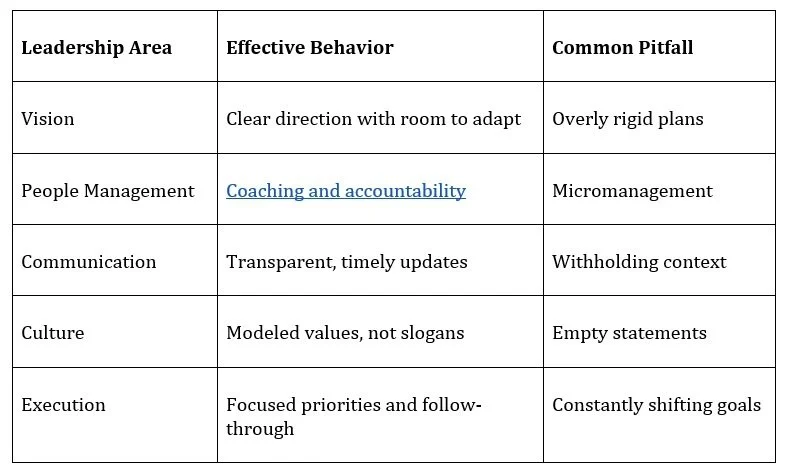
This table reflects patterns observed across industries, not theory.
FAQ: Leadership Questions Leaders Actually Ask
Is leadership the same as management?
No. Management focuses on processes and execution; leadership focuses on direction, alignment, and influence. Strong organizations need both.
Can leadership be learned later in a career?
Absolutely. Leadership develops through experience, feedback, and intentional practice, not age or title.
How do leaders build trust quickly?
By being consistent, transparent, and reliable. Trust grows when words and actions align over time.
Conclusion
Effective business leadership is not defined by style or status but by behavior under pressure. Leaders who combine clarity, integrity, and adaptability create environments where people perform and grow. The qualities outlined here are not trends; they are fundamentals. Practiced consistently, they turn authority into influence, and strategy into results.